


Everyone asks this question before fitting a tuning module: will my fuel consumption go up or down? The honest answer is — it depends entirely on how you drive.
Fit a chip and carry on driving as you did before? You’ll probably use 10–15% less fuel. Fit the same chip and start making use of all that extra power? Yes, you’ll burn more. Let me explain what’s actually happening with your engine.
How Your Driving Style Determines Fuel Consumption
Fuel consumption isn’t just about the hardware in your engine. It’s about what you do with the accelerator pedal.
Light-footed drivers who accelerate gently and maintain steady speeds typically see fuel savings after fitting a tuning module. Why? Because the extra torque means the engine doesn’t work as hard to maintain speed or accelerate moderately. Less engine load means less fuel.
Drivers who use the newfound power constantly — hard acceleration, high speeds, frequent overtaking on the motorway — will burn more fuel. That’s simply physics. More power output requires more fuel input.
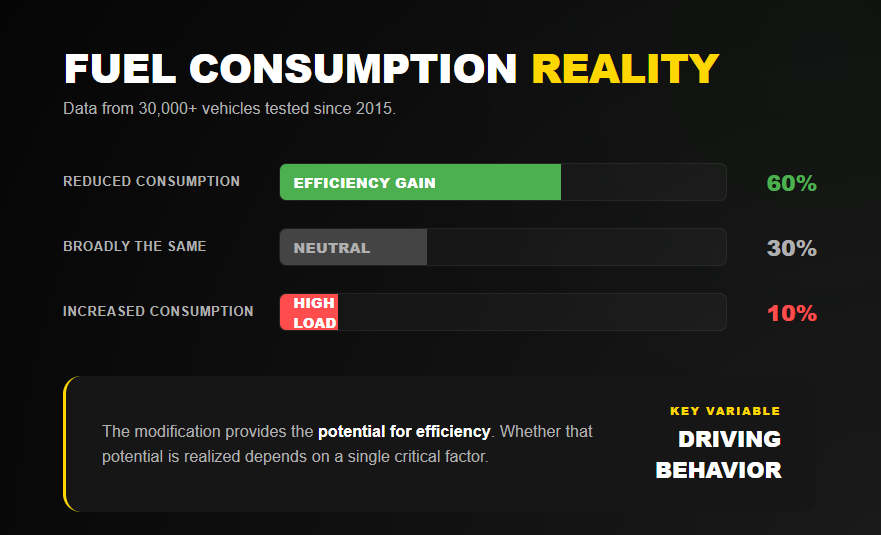
GAN’s data from testing over 30,000 vehicles since 2015 shows the split quite clearly: roughly 60% of drivers see reduced fuel consumption, 30% see broadly the same consumption, and 10% see increased consumption. The difference? Driving behaviour.
How GAN GA+ Works on Naturally Aspirated Engines
Naturally aspirated engines — no turbo, no supercharger — use the GAN GA+ module. This module convinces your ECU to use more aggressive fuel maps, the kind manufacturers programme for high-performance driving but limit access to.
What changes: the air-fuel mixture gets optimised, ignition timing advances, and throttle response sharpens. You get up to 12% more power without any mechanical modifications.
Here’s the interesting part: GA+ includes an eco-mode that leans out the fuel mixture slightly whilst increasing air intake. This mode prioritises fuel economy over performance. Drivers using eco-mode see fuel savings of up to 15%, which is considerable for commercial vehicles or anyone doing a lot of motorway driving.
The caveat? GAN’s primary focus is increasing power. Fuel efficiency is a welcome side benefit, not the main goal. If you want maximum fuel savings, stick to eco-mode and drive conservatively.
How GAN GT Works on Turbocharged Engines
Turbocharged engines use the GAN GT module, which works differently. Rather than modifying fuel mixture directly, it intercepts boost pressure sensors (petrol engines) or fuel rail pressure sensors (diesel engines).
The process: GT reads the sensor showing, say, 1.5 bar of boost pressure. It modifies that signal downward to 1.3 bar before sending it to the ECU. The ECU thinks boost is low, so it requests more. Actual boost climbs to 1.8 bar. More air plus more fuel equals up to 30% more power.
GAN keeps these modifications within safe mechanical limits. Your turbocharger can handle the pressure increase — manufacturers simply chose not to use it. If something goes wrong and limits get exceeded, your engine management light will warn you. The factory ECU’s protection systems remain active throughout.
Fuel consumption on turbocharged engines with GT:
- Motorway driving at steady speeds: 10–15% reduction possible
- Mixed town and motorway driving: 5–10% reduction typical
- Aggressive driving using full power: 5–15% increase likely
Turbo-diesel drivers see the best results because diesels already run lean fuel mixtures, and the extra torque at low revs makes motorway cruising considerably more efficient.
| Driving Scenario | Naturally Aspirated + GA+ | Turbocharged + GT |
| Conservative motorway | -10% to -15% | -10% to -15% |
| Mixed driving (eco-mode) | -5% to -10% | -8% to -12% |
| Mixed driving (sport mode) | 0% to -5% | -3% to -7% |
| Aggressive driving | +5% to +10% | +5% to +15% |
These figures come from GAN’s testing across 8 countries with different fuel qualities, climates, and driving conditions.
Why City Driving Makes Fuel Consumption Unpredictable
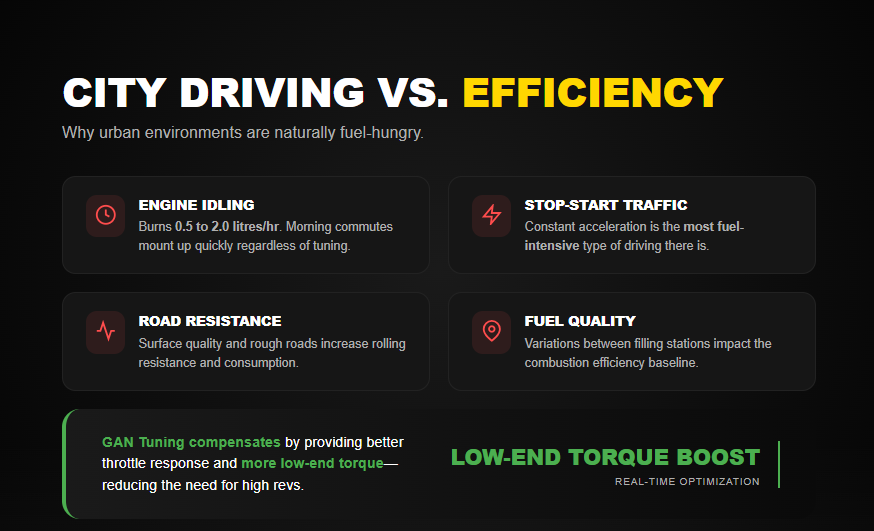
Trying to measure fuel economy accurately in urban driving is basically impossible. Too many variables interfere with the numbers.
Stop-start traffic means constant acceleration and braking — the most fuel-intensive type of driving there is. Road surface quality matters (rough roads mean more rolling resistance). Fuel quality varies between filling stations. And sitting in traffic with the engine idling burns 0.5 to 2 litres per hour depending on engine size, which mounts up quickly during the morning commute.
A tuning module helps somewhat by giving you better throttle response and more low-end torque, so you’re not revving hard just to pull away from the lights or merge onto a dual carriageway. But city driving will always be fuel-hungry regardless of tuning.
Question: Can I actually save money on fuel with a tuning module? Answer: If you drive conservatively and use eco-mode, yes. Commercial drivers running diesel vans on motorways see the biggest savings — up to 15% reduction over thousands of kilometres. That adds up considerably. But if you use the extra power frequently, you’ll spend more on fuel than you save.
Question: Does the extra power mean I’m always using more fuel, even at idle? Answer: No. At idle and light throttle, fuel consumption is essentially unchanged. The module only requests more fuel when you’re actually using the extra power. Cruise at 70 mph on the motorway in the same gear as before, and you’re using the same or slightly less fuel because of the improved torque curve.
Winter Driving Makes Everything Worse
Winter is tough on fuel economy, tuning module or not. Your car burns extra fuel for several reasons that have nothing to do with chip tuning.
Cold starts require rich fuel mixtures to get the engine running properly. Warming the engine before it reaches operating temperature means combustion isn’t yet efficient. Running the heater, rear demister, heated seats, and headlights constantly drains power that the alternator has to replace, which loads the engine further.
Winter tyres have higher rolling resistance than summer tyres. Cold, dense air creates more aerodynamic drag. Wet roads, standing water, and the occasional frost or ice all increase resistance. Everything works against you — and British winters, wet as they reliably are, don’t help matters.
GAN modules help somewhat by optimising combustion and torque delivery, potentially saving around 1–1.5 litres per tank in winter conditions. But winter will always be worse than summer for fuel economy, full stop.
The Acceleration Paradox: More Power Can Mean Less Fuel
This seems counterintuitive, but it’s actually true. Acceleration is when engines consume the most fuel. The longer you spend accelerating, the more fuel you burn.
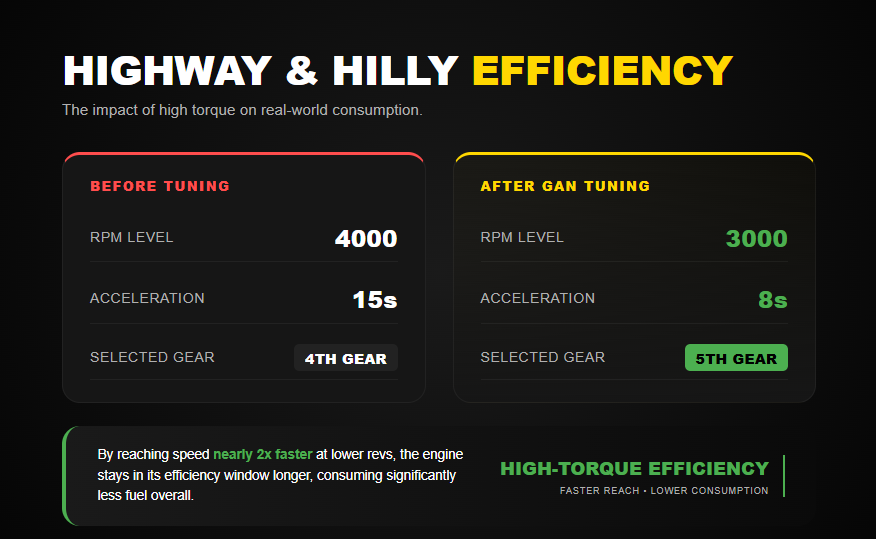
With a tuning module, you’ve got 20–30% more torque throughout the power band. That means you reach motorway speed faster and spend less total time in the high-fuel-consumption acceleration phase. You might burn slightly more fuel per second during that acceleration, but the shorter duration means less overall fuel consumed.
This is especially noticeable on motorways with frequent slip roads or on hilly roads — anyone who regularly drives out of London on the M25 will know exactly what this feels like. Before tuning: you drop to fourth gear, rev to 4,000 rpm, take 15 seconds to reach speed. After tuning: you stay in fifth, hit 3,000 rpm, reach speed in 8 seconds. The second scenario uses less fuel overall.
Turbo-diesel drivers see this benefit most clearly. The extra torque at low revs means they rarely need to change down, which keeps the engine in its most efficient operating range.
What Actually Happens After Fitting a GAN Module
Based on real-world data from 30,000+ vehicles tested since 2015, here’s what typically happens.
You’ll feel an immediate power increase — 20–30% on turbocharged engines, 10–12% on naturally aspirated. Throttle response sharpens noticeably. The engine pulls harder from lower revs.
Fuel consumption in the first few weeks usually nudges up slightly because you’re exploring the new power. That’s perfectly normal. After the novelty wears off and you return to your usual driving, fuel consumption typically drops below your pre-tuning baseline.
The improved torque curve means fewer gear changes, less time at high revs, and more efficient motorway cruising. Use eco-mode and drive conservatively, and you’ll see the maximum fuel savings. Use sport mode and drive accordingly, and you’ll burn more fuel — but that’s a choice, not an unavoidable consequence of tuning.
Engineers with over 20 years of calibration experience designed these modules specifically to improve both power and efficiency. The technology delivers both — but you decide which benefit you prioritise through your right foot.
Articoli utili sul chip tuning:
You’ve probably seen comments online claiming tuning boxes are a con. The argument usually goes something like this: “There’s nothing technically complex about these boxes. They just alter sensor signals. Zero innovation. No feedback. Pure deception.” Sounds fairly damning, doesn’t it? Except the people making these claims are usually OBD tuning shops trying to sell […]
Your car’s ECU is basically a small computer that runs your engine. That’s it. Everything else – all the power increases, fuel mapping, sensor reading – flows from that one fact. Understanding what an ECU actually does makes it way easier to understand how chip tuning works and why it’s even possible. So let’s break […]
Want more power from your car? There are essentially two ways to go about it: plug in an additional control unit, or tamper with your factory ECU software. One keeps your warranty intact. The other doesn’t. Let me break down exactly what happens with each method, because there’s a fair amount of confusion out there. […]


Contact us via WhatsApp