


The short answer: it depends on the type of chip tuning and whether dealers can prove it caused the problem.
External modules like GAN Tuning’s? Removable with zero trace, so dealers can’t detect them if you unplug before a service. ECU remapping? Leaves permanent traces dealers can spot immediately. Rather a significant difference.
Here’s what actually happens with warranties when you modify your car.
Two types of warranty you need to understand
Your car comes with two separate warranty protections, and they work quite differently.
Mandatory manufacturer warranty (minimum 2 years)
This is legally required consumer protection. Manufacturers must fix defects that aren’t caused by owner abuse or modifications. The key word is “caused by.” If you install a tuning module and your gearbox fails, the dealer has to prove the module caused that failure. If they can’t prove causation, they’re legally obliged to honour the warranty.
Extended dealership warranty (often 3–5 years)
This is additional coverage the dealership offers, usually detailed in your purchase contract. Dealerships can refuse this warranty if they can prove a modification caused the problem. But again — they need actual proof, not simply “we found a modification.”
Think of it like a phone warranty. Drop your phone and crack the screen? Not covered — physical damage from user error. Battery dies after six months of normal use? Covered — that’s a defect entirely unrelated to anything you did.
Burden of proof is on the dealer
Here’s what most people don’t realise: dealers can’t simply void your warranty because they found a modification. They have to prove that modification caused the specific problem you’re claiming.
Your stereo stops working and they find a tuning module? They can’t refuse warranty coverage unless they can explain how the tuning module damaged the stereo. It doesn’t matter that the module exists — what matters is whether it caused that specific failure.
Your turbocharger fails after 50,000 miles and you’ve been running a boost-increase module? Now they’ve got a case for causation. Turbo works harder → more stress → premature failure. That’s a direct link.
Real-world scenario from GAN Tuning’s 30,000+ tested vehicles:
Engine develops a coolant leak at 30,000 miles. Owner has a GAN module installed. Dealer inspects, finds the leak is from a failed water pump bearing — a known defect for that model. No connection between the tuning module (which affects fuel and boost) and a water pump bearing failure. Warranty claim approved.
Same car, engine destroys a piston at 40,000 miles. Investigation shows the piston failed from excessive cylinder pressure caused by running too much boost. Owner was running sport mode constantly on cheap petrol. Direct causation proved. Warranty claim denied.
The difference? Provable cause and effect.
What if dealers try to void your warranty anyway?
Some dealers will attempt to deny warranty claims the moment they see any modification, hoping you won’t push back. Don’t simply accept this.
In the UK, the Consumer Rights Act 2015 provides considerable protection here. If a dealer refuses a legitimate warranty claim, you can escalate to the Motor Ombudsman or Trading Standards — both of which investigate whether the refusal is justified. The Financial Ombudsman is also relevant if the dispute touches on a finance agreement.
The dealer has to provide technical evidence showing how your modification caused the failure. “Customer installed an aftermarket part” isn’t sufficient. They need engineering analysis proving causation.
From GAN Tuning’s experience across 8 countries: most warranty disputes over external modules get resolved in the owner’s favour because dealers simply can’t prove causation for unrelated failures.
| Failure type | Likely warranty outcome with external module |
| Electrical issues (stereo, windows, sensors) | Covered — no proven connection to tuning |
| Gearbox problems | Covered — tuning doesn’t modify the gearbox |
| Suspension/brake failures | Covered — completely unrelated to engine tuning |
| Engine failure with evidence of over-boost | Denied — direct causation provable |
| Turbocharger failure (heavy use, sport mode) | Possibly denied — causation arguable |
| Engine failure from manufacturing defect | Covered — defect existed independent of tuning |
How external modules preserve warranties better than ECU remapping
ECU remapping leaves permanent digital fingerprints. When dealers plug in their diagnostic equipment, they can see:
- Software version doesn’t match factory specifications
- Checksums in ECU memory are different
- Calibration dates show recent modifications
- Sometimes specific flags indicating a reflash occurred
There’s no hiding it. Once you’ve remapped the ECU, dealers know. Even if you reflash back to stock, the history is often visible in ECU logs.
External modules from GAN work completely differently. They sit between sensors and the ECU, modifying signals in real-time. When you unplug the module:
- No software changes in ECU memory
- No modified checksums
- No calibration date changes
- No flags or error codes
- Zero trace in diagnostic logs
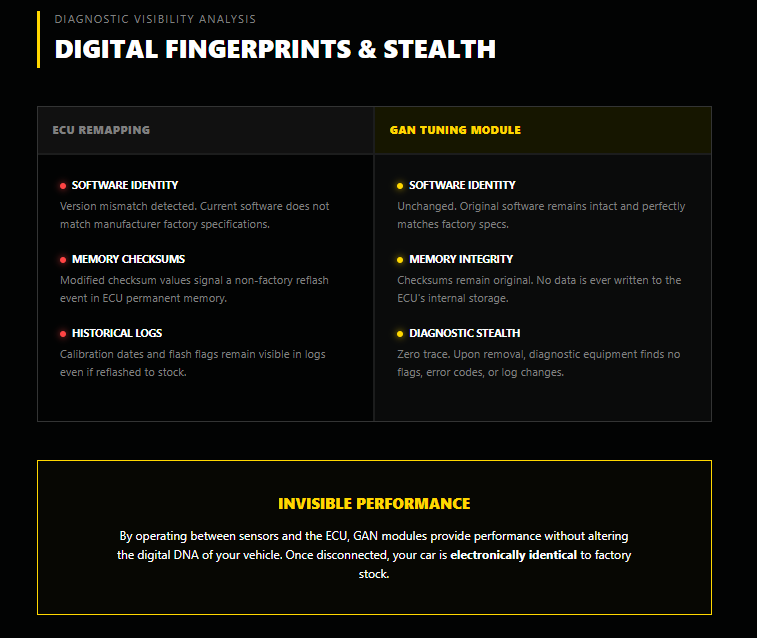
From the ECU’s perspective, nothing ever happened. Dealers literally cannot tell you had a module installed unless they physically see it connected during the inspection.
There’s an important insurance angle here as well. In the UK, performance modifications — including ECU remaps — must be declared to your insurer. Failing to do so can invalidate your policy entirely. Because an external tuning module is a removable, temporary modification that leaves no trace on the ECU, it doesn’t carry the same declaration complications as a permanent remap. Worth bearing in mind before you commit to any modification.
Question: Can dealers detect a tuning module during a regular service?
Answer: Only if it’s physically installed when they inspect. External modules like GAN’s are completely invisible in diagnostic software. Remove it before your service appointment, and there’s nothing in the ECU’s memory to indicate it was ever there. This is fundamentally different from ECU remapping, which leaves permanent digital traces.
Question: What if I forget to remove the module before a service?
Answer: If a technician spots it during a visual inspection, they’ll probably ask about it. At that point, you can remove it — and the dealer still can’t prove how long it was installed or whether it caused any issues. They’d need to demonstrate direct causation to deny a warranty claim. Most unrelated failures (electrical, suspension, gearbox) have no provable connection to engine tuning.
How GAN modules actually work (and why they’re safer)
Understanding what the module does helps clarify why it’s a more warranty-friendly option than ECU remapping.
GAN GA+ (naturally aspirated engines): Optimises throttle response and fuel delivery by accessing the ECU’s existing high-performance maps. These maps already exist in your factory ECU — manufacturers programme them in but restrict access. The module tells the ECU to use them. No safety systems disabled, no protection limits removed. You get up to 12% more power.
GAN GT (turbocharged engines): Modifies boost pressure sensor signals so the ECU allows more boost. Your turbocharger can handle 2.0 bar but the factory limits it to 1.4 bar. The module tells the ECU it’s seeing 1.2 bar when actual boost is 1.7 bar. The ECU compensates by requesting more boost, unlocking performance the hardware already supported — up to 30% more power.
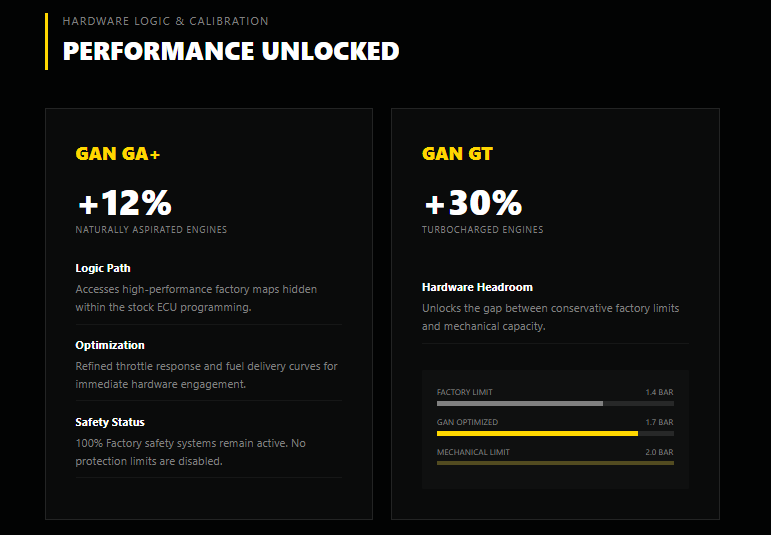
The critical point: factory safety systems remain active throughout. If knock sensors detect detonation, the factory ECU still pulls timing. If oil pressure drops, the factory ECU still limits power. All the manufacturer’s protection algorithms keep running as intended.
Engineers with over 20 years of calibration experience designed GAN Tuning’s modules to work within factory safety parameters. That’s why they can offer a €5,000 engine guarantee for 2 years — they’re confident the modules won’t cause failures.
Installation is reversible in minutes
Installing a GAN module takes approximately 15 minutes. Removing it takes under 60 seconds via the smartphone app, and the car returns to factory settings instantly. This reversibility is the key to preserving your warranty.
Before any dealer service appointment: remove the module via the app, store it safely. After the service: reinstall it. The factory ECU has no memory of the module ever being connected.
Compare this to ECU remapping, where reversing the flash means paying for another reflash (often several hundred pounds), risking ECU corruption during the process, and still potentially leaving traces in ECU memory that dealers can detect.
The honest bottom line on warranties
External tuning modules like GAN Tuning’s preserve warranties better than any other performance modification because:
- They’re completely removable with zero digital trace
- Factory safety systems remain fully active
- Dealers must prove causation to deny claims, which is difficult for unrelated failures
- Mandatory warranty protection stays in effect unless direct causation is proved
ECU remapping voids warranties far more readily because dealers can detect it, and you’ve permanently modified factory programming.
If you want more power but need to keep your warranty — and your insurance policy — intact, external modules are the only realistic option. Just remember to remove them before service appointments.
The legal reality: dealers need proof of causation, not just proof of modification. Most failures — electrical, gearbox, suspension — have no provable connection to engine tuning. But be realistic about it: if you destroy your engine running maximum boost on cheap petrol, don’t expect warranty coverage.
Articoli utili sul chip tuning:

Your car’s engine isn’t running at full capacity. Never has been. Manufacturers deliberately programme engines to produce less power than they’re actually capable of, and there are some fairly specific reasons why. This isn’t some conspiracy theory — it’s basic automotive economics and engineering. Let me show you what’s actually going on. What Actually Happens […]

You’ve probably seen comments online claiming tuning boxes are a con. The argument usually goes something like this: “There’s nothing technically complex about these boxes. They just alter sensor signals. Zero innovation. No feedback. Pure deception.” Sounds fairly damning, doesn’t it? Except the people making these claims are usually OBD tuning shops trying to sell […]

Your car’s ECU is basically a small computer that runs your engine. That’s it. Everything else – all the power increases, fuel mapping, sensor reading – flows from that one fact. Understanding what an ECU actually does makes it way easier to understand how chip tuning works and why it’s even possible. So let’s break […]


Contact us via WhatsApp