


Most chip tuning articles are written by companies selling tuning services. They highlight benefits and downplay risks because they want your money. This article is different.
What chip tuning actually does, how the two main methods compare honestly, and what the real risks are to warranties and engine longevity — all laid out plainly. What you do with this information is your decision.
What chip tuning actually means
Chip tuning modifies your car’s electronics to increase power output. Sometimes — particularly with commercial vehicles or agricultural equipment — the goal is reducing fuel consumption instead. But for most people, it’s about getting more power from the engine they already have.
There are two fundamentally different approaches: adding an external control module, or reprogramming your factory ECU software. These methods work differently, carry different risks, and affect warranties differently. Understanding the real distinctions matters, because marketing materials often blur them together deliberately.
External control modules — how they work
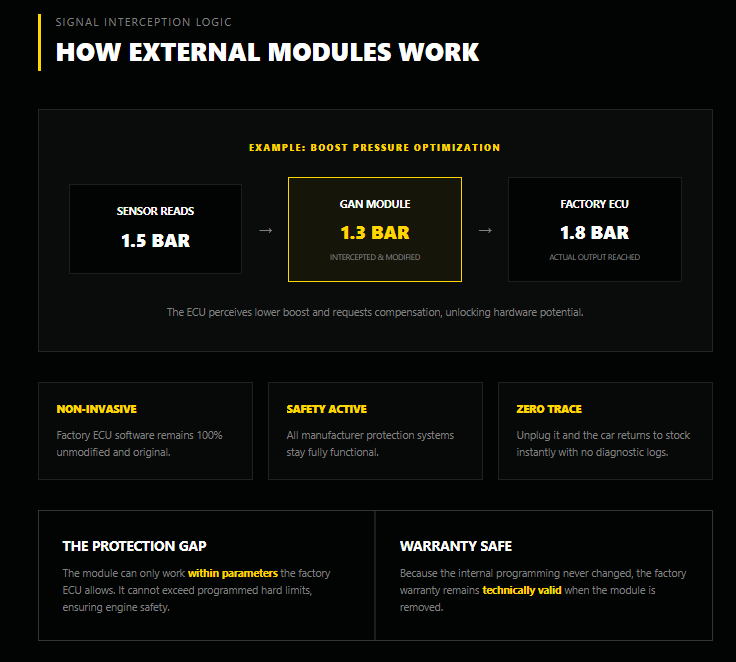
An external module (sometimes called a tuning box or chip) connects between your engine sensors and your factory ECU. It intercepts sensor signals, modifies them based on programmed algorithms, then sends the altered signals to the ECU.
Example of how this works:
Your boost pressure sensor reads 1.5 bar. The module intercepts this signal and changes it to 1.3 bar before sending it to the ECU. The ECU thinks boost is low, so it requests more boost pressure to compensate. Actual boost climbs to 1.8 bar, producing more power.
Key characteristics of external modules:
- Factory ECU and its software remain completely unmodified
- All manufacturer safety systems stay active and functional
- Completely removable — unplug it and the car returns to stock instantly
- No trace left in ECU memory or diagnostic logs
- Factory warranty technically remains valid (if removed before service)
The limitation: external modules can only work within the parameters the factory ECU allows. If the ECU has hard limits programmed in — maximum fuel injection duration, maximum boost pressure — the module can’t exceed those limits without the ECU throwing error codes.
ECU remapping — how it works
ECU remapping (also called ECU flashing or OBD tuning) involves pulling the factory software from your ECU, modifying the calibration parameters on a computer, then writing the modified software back to the ECU.
What gets changed:
- Fuel maps (how much fuel to inject at various RPM and load conditions)
- Ignition timing maps (when to fire spark plugs)
- Boost pressure limits (maximum allowed turbo boost)
- Torque limiters (often disabled completely)
- Speed limiters (often removed)
- Safety parameters (often modified or disabled)
Key characteristics of ECU remapping:
- Factory ECU software is permanently modified
- Can remove hard limits that external modules can’t bypass
- Potentially 2–3% more power than external modules at absolute maximum
- Leaves permanent traces in ECU diagnostic logs
- Voids warranty — dealers can detect the modifications
- Requires reflashing to return to stock (costs money, risks ECU damage)
The advantage: complete control over all ECU parameters. The disadvantage: permanent modification with permanent consequences.
The honest comparison nobody publishes
Here’s the comparison most tuning companies won’t give you, because it doesn’t make one method look clearly superior.
| Factor | External module | ECU remapping |
| Maximum power gain | Up to 30% (turbo) / 12% (NA) | Up to 32% (turbo) / 13% (NA) |
| Warranty impact | Technically preserved if removed | Immediately void, detectable |
| Safety systems | All factory systems remain active | Often disabled or modified |
| Reversibility | Instant (unplug) | Requires paid reflash |
| Installation risk | Zero ECU damage risk | Can brick ECU during flash |
| Cost (initial) | €300–800 typical | €400–1,000 typical |
| Cost (reversal) | €0 (just unplug) | €300–500 (reflash required) |
| Adjustability | Multiple modes via app | Fixed tune unless reflashed again |
| Detection by dealers | Impossible when removed | Easily detected in ECU logs |
Based on GAN Tuning’s testing across 30,000+ vehicles in 8 countries, the performance difference between good external modules and good ECU remapping is typically 2–3% at most. That’s within measurement error on most dynos.
The real differences are warranty preservation, safety systems, and reversibility — not ultimate power output.
What actually happens to warranties
This is where marketing materials get deliberately vague. Here’s the plain version.
With external modules:
Your factory ECU and its software are never modified. When you remove the module before a dealer service appointment, there is literally nothing in the ECU’s memory indicating it was ever connected — no software version changes, no modified checksums, no error codes, no flags. Undetectable at an MOT inspection for precisely the same reason.
Can the dealer void your warranty? Only if they physically see the module installed during inspection, and they can prove it caused the specific problem you’re claiming. If your stereo stops working and they happen to spot a tuning module, they can’t refuse the stereo repair unless they prove causation.
There’s an insurance dimension here too. In the UK, performance modifications must be declared to your insurer — fail to do so and you risk invalidating your policy entirely. An external module that leaves no trace on the ECU puts you in a fundamentally different position from a permanent remap. It’s a removable, temporary modification, which is a meaningful distinction when your insurer asks questions.
Reality from GAN Tuning’s experience across 8 countries: most warranty claims with external modules get honoured because dealers can’t prove causation for unrelated failures, and most owners remember to remove modules before a service.
With ECU remapping:
The moment you reflash the ECU, permanent digital fingerprints appear. When dealers plug in their diagnostic equipment, they see software versions that don’t match factory specifications, calibration dates showing recent modifications, and sometimes specific anti-tuning flags.
There’s no hiding it. Even if you pay to reflash back to stock, dealers can often detect the ECU was previously modified through software version history.
Can the dealer void your warranty? Yes, immediately, for any powertrain-related claim. They don’t need to prove the remapping caused the problem — just that you modified the car contrary to manufacturer specifications.
Reality: ECU remapping voids powertrain warranties. Anyone telling you otherwise is not being straight with you.
Real engine longevity concerns
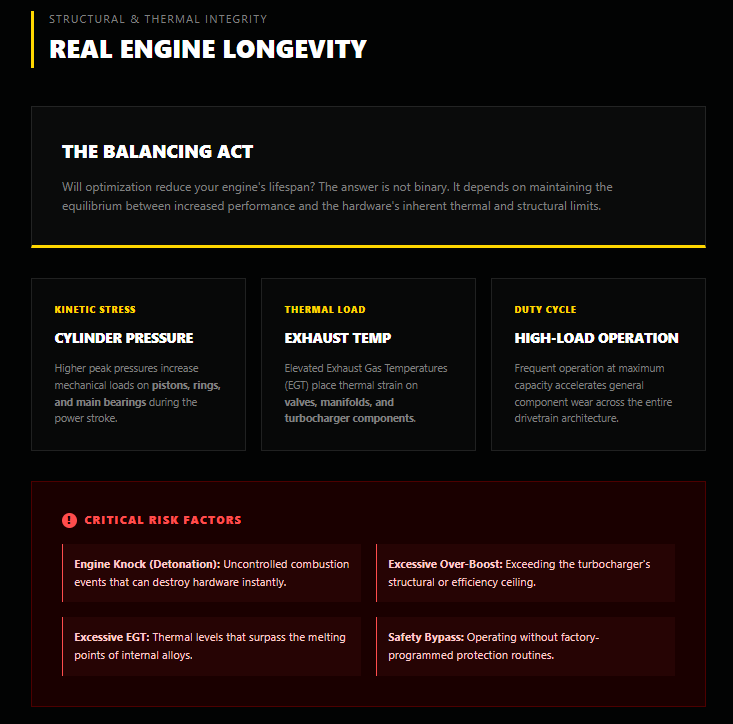
Will chip tuning reduce your engine’s lifespan? The honest answer: it depends on several factors.
What increases engine wear:
- Higher cylinder pressures (more stress on pistons, rings, bearings)
- Higher exhaust gas temperatures (more stress on valves, turbocharger)
- More frequent high-load operation (more stress on all components)
- Running the engine outside safe parameters (knock, over-boost, excessive EGT)
External modules and engine wear:
GAN modules stay within manufacturer-safe mechanical limits. Turbochargers rated for 2.0 bar aren’t pushed past 1.8 bar. Fuel injectors rated for 2,200 bar aren’t pushed past 2,000 bar. Factory safety systems remain active to protect against knock, over-temperature, and other dangerous conditions.
Engineers with over 20 years of calibration experience designed these limits specifically to avoid accelerated wear. That’s why GAN Tuning offers a €5,000 engine guarantee for 2 years — they’re confident the modules won’t cause premature failures.
ECU remapping and engine wear:
This depends entirely on who did the tuning and how conservative they were. Good tuners with dyno testing and proper calibration can produce safe maps that don’t significantly increase wear. Poor tuners who simply increase boost and fuel without proper testing can produce maps that destroy engines.
The problem: you can’t easily verify tuner quality before paying them. And many tuners disable safety systems — knock control, EGT limits, torque limiters — to squeeze out maximum power, which directly increases engine wear.
Real-world data from GAN Tuning’s 30,000+ tested vehicles:
Engines with external modules show no statistically significant difference in failure rates compared to stock engines over 100,000+ miles of operation. The €5,000 guarantee backs this up — if failures were common, offering it wouldn’t be viable.
ECU remapping results vary considerably depending on tuner quality. Well-executed remapping shows similar longevity to stock. Poorly done remapping shows increased failures, particularly turbocharger and piston failures.
The risks nobody mentions
Risk 1: ECU damage during flashing
Remapping requires communicating with the ECU over the OBD port or by directly accessing the ECU’s circuit board. If this process gets interrupted — battery voltage drop, connection problem, software error — you can corrupt the ECU software. The car won’t start. The ECU needs replacement (€800–2,000 depending on model) or recovery (€300–500 if possible).
This happens. Not often, but it happens. External modules carry zero risk of this because they never communicate with the ECU — they only modify sensor signals.
Risk 2: Poor calibration destroying engines
Bad ECU remapping can request power levels that exceed component limits. Too much boost pressure damages turbochargers. Too much cylinder pressure cracks pistons. Too lean a fuel mixture burns valves. Too advanced ignition timing causes detonation.
Poor external modules can cause similar problems, but they’re constrained by factory ECU safety systems. The factory ECU will throw error codes and enter limp mode if parameters become dangerous. With ECU remapping, those safety systems are often disabled.
Risk 3: Fuel quality dependency
More aggressive tuning requires better fuel quality. If you’re tuned for 98 octane and fill up with 95 octane, knock can occur. Stock ECU programming includes knock control that retards timing when knock is detected. Many ECU remaps disable or reduce this safety feature to maximise power.
External modules typically leave knock control active, so the engine protects itself if fuel quality drops — relevant in the UK where fuel quality varies between forecourts.

What GAN Tuning actually recommends (and why)
GAN Tuning recommends external modules over ECU remapping for most drivers because warranty preservation matters to most people, factory safety systems protecting the engine should remain active, reversibility provides genuine flexibility, and the 2–3% maximum power difference simply isn’t worth the downsides.
ECU remapping does make sense in specific situations: heavily modified engines with upgraded turbos and larger injectors that exceed what factory ECU parameters allow, or competition vehicles where warranty is irrelevant and maximum power is the sole objective. Track day regulars at Silverstone or Brands Hatch running a dedicated circuit car fall into this category.
For street-driven cars under warranty, external modules are the lower-risk option. This isn’t marketing — it’s risk analysis.
Setting realistic expectations
Don’t expect magic. Chip tuning unlocks performance headroom manufacturers deliberately left unused, but it doesn’t violate physics.
Realistic gains:
- Turbocharged engines: up to 30% power, 25–35% torque
- Naturally aspirated engines: up to 12% power, 12–15% torque
Realistic fuel economy changes:
- Conservative driving: 5–15% improvement possible
- Aggressive driving: 5–15% increase likely
- Mixed driving: roughly neutral
Realistic warranty impact:
- External modules: preserved if removed before service
- ECU remapping: void for powertrain claims
Realistic longevity impact:
- Well-done tuning within safe limits: minimal difference
- Poorly done tuning exceeding safe limits: significantly reduced lifespan
The difference between good and bad outcomes is choosing quality tuning from companies with extensive testing data behind them, not budget solutions from unknown tuners with a laptop and an optimistic attitude.
The bottom line without marketing spin
External modules and ECU remapping both increase power. They work differently, have different trade-offs, and suit different situations.
For most street-driven cars: external modules preserve warranties, maintain safety systems, and deliver 95% of the power gains with none of the permanent consequences.
For heavily modified competition cars: ECU remapping provides the complete control needed to tune around upgraded components.
GAN Tuning’s recommendation is based on 30,000+ vehicles tested across 8 countries. External modules produce reliable, repeatable results with minimal risk for the vast majority of drivers.
What you do is your decision. At least now you have honest information to base it on.
Articoli utili sul chip tuning:
Naturally aspirated engines gain less from chip tuning than turbocharged engines. That’s simply physics. You’ll see around 10–12% power increase, perhaps 15% torque increase at best. But that 10–12% is still worth having. Here’s what’s actually possible with naturally aspirated engines and why the gains are more modest compared to forced induction motors. What makes […]

Want more power from your car? There are essentially two ways to go about it: plug in an additional control unit, or tamper with your factory ECU software. One keeps your warranty intact. The other doesn’t. Let me break down exactly what happens with each method, because there’s a fair amount of confusion out there. […]
Everyone asks this question before fitting a tuning module: will my fuel consumption go up or down? The honest answer is — it depends entirely on how you drive. Fit a chip and carry on driving as you did before? You’ll probably use 10–15% less fuel. Fit the same chip and start making use of […]


Contact us via WhatsApp