





Chiptuning Seat Ibiza
Up to 30% more power for your Seat Ibiza
Our catalogue lists 4 generations and 57 engines for the Seat Ibiza (2002 →). For 33 turbo engines, the options are the GAN GT and GAN GTL tuning boxes: the GAN GT adds +15 to +51 hp (GAN GT from 329 EUR, GAN GTL from 219 EUR). For 24 engines, the options are the GAN GA and GAN GA+: the GAN GA+ adds +6 to +19 hp (GAN GA+ from 189 EUR).
Which Seat Ibiza do you have?
Start with the model year and chassis code. Then pick your engine by the power output shown in your vehicle documents.
Seat Ibiza remap: what the GAN box does and doesn’t do
More power and torque without rewriting the ECU or replacing any parts. Unlike a flash remap, the tuning box leaves the ECU software alone and only adjusts the engine sensor signals.
- Bluetoothchange modes from your phone
- 18 mapsfine-tuning for your engine
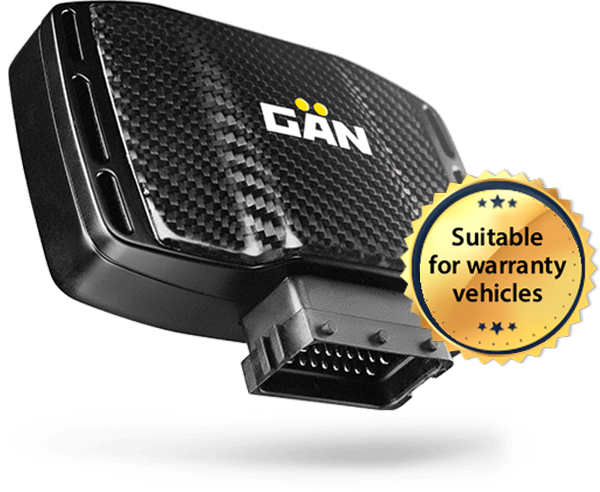
- 15 minutesfitted to the factory connectors
- IP67water and dust protection
- +51 hpwith the GAN GT on turbocharged engines
Across the Seat Ibiza range: +15 to +51 hp with the GAN GT or GAN GTL.
- +18 hpwith the GAN GA+ on naturally aspirated engines
Naturally aspirated Seat Ibiza engines pick up +6 to +18 hp.
- GAN APPpower control via smartphone
SPORT, DYNAMIC, ECO and STOCK modes in the GAN app.
- 50 daystest drive
Feel the difference or get your money back, excluding delivery costs.
Seat Ibiza chip tuning: engines and generations
Seat Ibiza remap: why the 6P is not a generation of its own
Ibiza codes are easy to misread, and the 6P is the one that catches people out: it looks like a generation, but it is not. It is the name of the second facelift of the Ibiza IV (6J), which arrived in mid-2015 and stayed in production until 2017. In Britain the Ibiza is usually called by its Mk number rather than by a 6L, 6J or 6F code, so both are given below. What matters to a tuning box is the engine, and the engines are grouped under four codes: 6L, 6J, 6P and 6F.
The 6L (Mk3) ran from 2002 to 2008, the 6J (Mk4) began in 2008 and the 6F (Mk5) in 2017. From May 2015 the petrol range changed, with the EA111 1.2 TSI replaced by the 1.0 Eco TSI and the EA211 1.2 TSI 90. The diesels followed in July 2015, when the 1.4 TDI common rail took over from the 1.2 TDI and the 1.6 TDI.
The Mk4 (6J): petrol and diesel engines
Body styles: the five-door hatchback and the three-door SC arrived in June 2008, and the ST estate followed in July 2010. Petrol choices start with the naturally aspirated 1.2 12V, 1.4 16V and 1.6 16V and go up to the turbocharged 1.2 TSI, rated at 86 or 105 hp. The 1.4 TSI FR (150 hp) pairs a supercharger with a turbocharger, while the 1.4 TSI ACT is rated at 140 hp.
Turbo petrols take the GAN GT, naturally aspirated ones the GAN GA+. The diesels are the 1.2 TDI CR 75, the common rail 1.6 TDI at 90 or 105 hp, and the pump-injector 1.4 TDI 80 and 1.9 TDI 90 and 105. All of them are turbocharged. If your diesel Ibiza mostly does short journeys, its DPF is the part to check first, before you add any power.
The Mk3 (6L) and the Mk5 (6F)
There are no TSI engines in the 6L. Its turbo petrol is the 1.8 T 20V: 150 hp in the FR and 180 hp in the Cupra. Apart from the naturally aspirated 1.9 SDI 64, the 6L diesels are all turbocharged, topping out at the 1.9 TDI with 130 hp in the FR and 160 hp in the Cupra. The 6F comes only as a five-door hatchback, and the catalogue lists its naturally aspirated 1.0 MPI engines at 65 and 75 hp.
The current Ibiza is a petrol car, with the 1.0 TSI rated at 95 or 115 hp. The 6F diesel did not last long: the 1.6 TDI with 115 hp was built from January 2018 to April 2019.
Seat Ibiza remapping: questions
What would the GAN GT add to a 6J Ibiza 1.2 TSI 105 and a 6P 1.0 TSI 95?
For the 6J 1.2 TSI the catalogue shows 105 hp and 175 Nm going up to 125 hp and 228 Nm. On the 6P, the 1.0 TSI figures are 95 hp and 160 Nm as standard and 124 hp and 208 Nm with the GAN GT. If the car has a DSG gearbox, have any hesitation or judder looked at first, because extra power does not make a worn gearbox better. Treat these as the stated gains for the engine type, not as a dyno reading of your own car. Across turbocharged engines, GAN quotes up to 30% more power.
Ibiza FR and Cupra: which engines did each version have?
On the 6L, the FR was offered with the 1.8 T at 150 hp or the 1.9 TDI at 130 hp, and the Cupra with the 1.8 T at 180 hp or the 1.9 TDI at 160 hp. The 6J FR has either the 1.4 TSI at 150 hp or the 2.0 TDI CR at 143 hp, while the 6J Cupra is petrol only: the 1.4 TSI at 179 hp. For the 6P Cupra the engine is the 1.8 TSI, rated at 192 hp.
Why do pump-injector and common rail TDIs get different gains?
The catalogue pairs the pump-injector 1.4 TDI and 1.9 TDI with the GAN GA+, which is rated at up to 12%. The common rail 1.6 TDI uses the GAN GT instead, with up to 30% more power.
What separates a Seat Ibiza remap from a tuning box?
A flash remap rewrites the software inside the engine control unit, and the GAN tuning box does not. It adjusts the signals from the engine sensors instead, so the factory software, its checksums and the flash counter all stay as they were. The ECU software is never changed, so your manufacturer's warranty is preserved, and you can take the box off whenever you like.
Will my insurer need to know about the tuning box?
Yes, declare it. British insurers treat extra power as a modification, so the safe course is to tell them before you fit the box. How they treat it varies from one insurer to another, so ask before you fit the box; the standard and tuned figures you will be asked for are in the table on this page.
Is a tuning module the same as a Stage 1 remap?
Not quite. Stage 1 usually means an ECU remap without replacing any parts. The tuning module also works without replacing parts, but it does not change the ECU software: it adjusts the sensor signals, comes off in about a minute, and the OFF button in the app restores the factory settings.