






Chiptuning Hyundai
Up to 30% more power for your Hyundai
Our Hyundai catalog covers 401 engines (models: 49, generations: 79). For 36% of the engines there are the GAN GT (up to 30% more power) and GAN GTL (up to 25%) tuning boxes; for the rest, the GAN GA and GAN GA+ (up to 12%). Each engine’s figures are on its own page.
Hyundai plug-in remap: no changes to the ECU software
The tuning box sits between the sensors and the engine control unit (ECU) and adjusts their signals – unlike a flash remap, which rewrites the ECU. Your manufacturer’s warranty is preserved: the ECU software is never changed, and the box can be removed at any time.
- Bluetoothchange modes from your phone
- 18 mapsfine-tuning for your engine
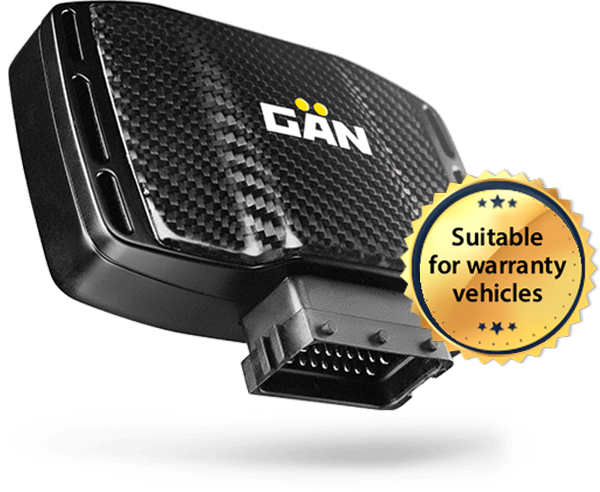
- 15 minutesfitted to the factory connectors
- IP67water and dust protection
- up to +30%more power with the GAN GT
Turbo engines pick up +22 to +67 hp, depending on the engine.
- up to +12%for naturally aspirated engines with the GAN GA+
GAN GA and GAN GA+ tuning boxes for 256 naturally aspirated engines from Hyundai; see the catalog for each engine’s figure.
- GAN APPpower control via smartphone
SPORT, DYNAMIC, ECO and STOCK modes in the GAN app.
- 50 daystest drive
Feel the difference or get your money back, excluding delivery costs.
Choose your Hyundai model
Each model lists its generations: one click takes you to a generation, two to an engine.
The biggest Hyundai gains
The six engines with the biggest gains in our catalogue. These are not typical figures but the top of the range.
| Model · generation | Engine | Fuel | STOCK | With GAN | Gain | Tuning boxes and prices |
|---|---|---|---|---|---|---|
| IX55/Veracruz IX55/Veracruz | 3.0 V6 CRDi | Diesel | 250 hp / 471 Nm | 317 hp / 587 Nm | +67 hp | GTL from 249 EUR GT from 399 EUR |
| IX55/Veracruz IX55/Veracruz | 3.0 V6 CRDi | Diesel | 239 hp / 451 Nm | 304 hp / 564 Nm | +65 hp | GTL from 249 EUR GT from 399 EUR |
| Santa Fe Santa Fe (II) 2006-12 | 2.2 CRDi | Diesel | 197 hp / 422 Nm | 252 hp / 530 Nm | +55 hp | GTL from 249 EUR GT from 399 EUR |
| Santa Fe Santa Fe (III) 2012-19 | 2.2 CRDi | Diesel | 197 hp / 421 Nm | 252 hp / 529 Nm | +55 hp | GTL from 249 EUR GT from 399 EUR |
| ix35 ix35 | 2.0 CRDi | Diesel | 184 hp / 383 Nm | 236 hp / 485 Nm | +52 hp | GTL from 249 EUR GT from 399 EUR |
| Santa Fe Santa Fe (II) 2006-12 | 2.0 CRDi | Diesel | 184 hp / 400 Nm | 236 hp / 502 Nm | +52 hp | GTL from 249 EUR GT from 399 EUR |
Hyundai remapping: questions
How do the Tucson III 1.6 GDI and 1.6 T-GDI differ when it comes to a tuning box?
On the naturally aspirated 1.6 GDI (132 hp) the GAN GA+ adds 16 hp and 19 Nm. Because the 1.6 T-GDI (177 hp) is turbocharged, it takes the GAN GT instead.
Which Hyundai diesels take the GAN GT?
The Santa Fe II 2.2 CRDi (197 hp) is rated at 422 Nm and reaches 252 hp and 530 Nm with the GAN GT. The Tucson III's 1.6 CRDi with 136 hp gains 39 hp and 93 Nm. Take these as the stated gains for this engine type, not a dyno reading from your car.
What does a tuning box add to the i30 N?
Gains are 41 hp and 100 Nm for the 2.0 T-GDI with 250 hp, and 47 hp and 100 Nm for the N Performance with 275 hp.
Tuning box or ECU remap on a Hyundai?
Most people who ask about Hyundai chip tuning mean an ECU remap, which rewrites the factory software in the engine control unit (ECU). The GAN box takes a different route, sitting between the engine sensors and the ECU, which leaves the factory software, checksums and flash counter as they were. Because the ECU software is never changed and the box can be removed at any time, your manufacturer's warranty is preserved.
Should I declare the GAN box to my insurer?
Yes, declare it. British insurers treat extra power as a modification, so the safe course is to tell them before you fit the box. How they treat it varies from one insurer to another, so ask before you fit the box; the standard and tuned figures you will be asked for are on your engine's page.
Will a tuning box affect my Hyundai warranty?
No. The box does not change the ECU software and can be removed at any time, so your manufacturer’s warranty is preserved. On top of that, we give an engine warranty: 2 years with the GAN GT, 1 year with the GAN GTL.
Tuning box or remap: which should I choose?
A flash remap permanently rewrites the maps in the ECU and leaves a trace in the flash counter. The GAN tuning box adjusts the sensor signals instead: the ECU stays in factory condition, and you can return the car to stock in about a minute. A flash remap can be the better choice if the engine has upgraded hardware, or if the car is out of warranty and you accept the risks.
Hyundai chip tuning: what to know about the engines
Hyundai remap or tuning box? One letter changes the box
A single letter in a Hyundai engine name can decide which tuning box you need. Two petrols sit side by side in the Tucson III: the 1.6 GDI with 132 hp and 161 Nm and the 1.6 T-GDI with 177 hp and 265 Nm. MPI is a naturally aspirated petrol with multi-point injection, GDI is also naturally aspirated but with direct injection, and T-GDI adds a turbo. CRDi is Hyundai's name for a common rail turbodiesel.
On the diesel side the Tucson III has the 1.7 CRDi (116 and 141 hp), the 2.0 CRDi (136 and 185 hp) and, from 2018, the 1.6 CRDi (116 and 136 hp). That is why the Tucson's naturally aspirated 1.6 GDI belongs with the GAN GA+, gaining 16 hp and 19 Nm, while the turbocharged 1.6 T-GDI needs the GAN GT. Between 2010 and 2015 the Tucson was sold in Europe as the Hyundai ix35, so look for it under that name. UK badges you will meet include i10, i20, i30, KONA, TUCSON, SANTA FE and N Line, with older cars such as the Getz, Accent and ix35.
The CRDi diesels, model by model
CRDi diesels take the GAN GT, and the catalogue gain on the Santa Fe 2.2 CRDi is 55 hp. Until 2008 the Santa Fe II had the 2.2 CRDi at 150 hp, and from November 2009 at 197 hp. The 2.0 CRDi with 150 hp arrived with the Santa Fe III, and from November 2015 its 2.2 CRDi made 200 hp. Smaller diesels, from the 1.4 and 1.6 CRDi up to the 2.0 CRDi, go into the i30 and the Tucson.
Since 2018 the Santa Fe IV has offered the 2.2 CRDi with 200 hp, plus a 2.0 CRDi with 150 hp for front-wheel drive. With a Hyundai diesel, check the build date: the same displacement came in several outputs. Older UK-market cars such as the Getz, Accent and i30 each have their own power and torque figures, so never read across from another generation.
Read moreShow less
Smartstream engines, mild hybrids and the N cars
Hyundai has called its new engines Smartstream since 2018; the letter gives the fuel and the number the displacement. The 48V mild hybrids are built on turbocharged engines: the 1.5 T-GDI with 160 hp in the i30, and the 1.6 CRDi with 136 hp. For a Hyundai i30 N remap or tuning box, start with the output: the 2.0 T-GDI makes 250 hp, the N Performance version 275 hp, and from 2021 the facelifted N Performance makes 280 hp. Both the 250 hp and the 275 hp versions are GAN GT engines.
Tuning listings put the i30 1.4 T-GDI at 140 hp and 242 Nm, the same as its catalogue row. Despite the name, the i30 Fastback is a five-door liftback of the i30, not a model of its own; blue marks the economical versions. In the Kona you get a 1.0 T-GDI with 120 hp or a 1.6 T-GDI with 177 hp, and the Kona N reaches 280 hp. In the catalogue the turbo T-GDI and CRDi engines are matched with the GAN GT (up to 30% more power), and the naturally aspirated MPI and GDI engines with the GAN GA+ (up to 12%).
Which Hyundai models are in the catalog
The catalog covers 49 models from Hyundai. The most engines are listed for the Santa Fe (49), Sonata (39) and Elantra (34). The biggest gain among the models is on the IX55/Veracruz: up to +67 hp.
Naturally aspirated Hyundai engines
For 256 naturally aspirated engines from Hyundai, there is the GAN GA+: up to 12% more power and up to 15% lower fuel consumption in ECO mode, which means better MPG. You can fit it yourself, in most cases in under 15 minutes.
How to find your Hyundai engine
Pick your model from the list above, then the generation by model year and chassis code, then the engine by the power output in your registration document. The engine page shows the exact gain and the price of the box.