





Chiptuning VW
Up to 30% more power for your Volkswagen
Our Volkswagen catalog covers 652 engines (models: 39, generations: 66). For 66% of the engines there are the GAN GT (up to 30% more power) and GAN GTL (up to 25%) tuning boxes; for the rest, the GAN GA and GAN GA+ (up to 12%). Each engine’s figures are on its own page.
Volkswagen plug-in remap: no changes to the ECU software
The tuning box sits between the sensors and the engine control unit (ECU) and adjusts their signals – unlike a flash remap, which rewrites the ECU. Your manufacturer’s warranty is preserved: the ECU software is never changed, and the box can be removed at any time.
- Bluetoothchange modes from your phone
- 18 mapsfine-tuning for your engine
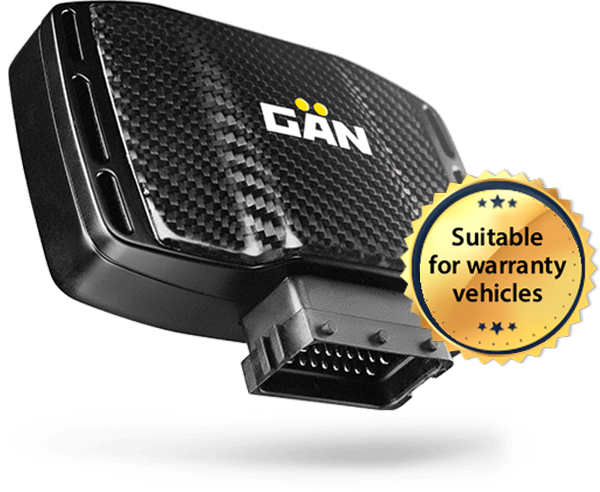
- 15 minutesfitted to the factory connectors
- IP67water and dust protection
- up to +30%more power with the GAN GT
Turbo engines pick up +15 to +74 hp, depending on the engine.
- up to +12%for naturally aspirated engines with the GAN GA+
GAN GA and GAN GA+ tuning boxes for 153 naturally aspirated engines from Volkswagen; see the catalog for each engine’s figure.
- GAN APPpower control via smartphone
SPORT, DYNAMIC, ECO and STOCK modes in the GAN app.
- 50 daystest drive
Feel the difference or get your money back, excluding delivery costs.
Choose your Volkswagen model
Each model lists its generations: one click takes you to a generation, two to an engine.
The biggest Volkswagen gains
The six engines with the biggest gains in our catalogue. These are not typical figures but the top of the range.
| Model · generation | Engine | Fuel | STOCK | With GAN | Gain | Tuning boxes and prices |
|---|---|---|---|---|---|---|
| Golf Golf (VII) 2013-> | 2.0 TSI R | Petrol | 290 hp / 440 Nm | 364 hp / 541 Nm | +74 hp | GTL from 249 EUR GT from 399 EUR |
| Golf Golf (VI) 2009-12 | 2.0 R | Petrol | 271 hp / 350 Nm | 342 hp / 445 Nm | +71 hp | GTL from 249 EUR GT from 399 EUR |
| Golf Golf (VI) 2009-12 | 2.0 TSI R | Petrol | 270 hp / 350 Nm | 341 hp / 445 Nm | +71 hp | GTL from 249 EUR GT from 399 EUR |
| Golf Golf (VII) 2013-> | 2.0 GTI | Petrol | 265 hp / 350 Nm | 335 hp / 445 Nm | +70 hp | GTL from 249 EUR GT from 399 EUR |
| Touareg Touareg (II) 2010-> | 3.0 TSI | Petrol | 333 hp / 440 Nm | 402 hp / 526 Nm | +69 hp | GTL from 279 EUR GT from 459 EUR |
| Touareg Touareg (II) 2010-> | 3.0 V6 TSHybrid | Hybrid | 333 hp / 440 Nm | 402 hp / 526 Nm | +69 hp | GTL from 279 EUR GT from 459 EUR |
Volkswagen remapping: questions
How do I tell a Twincharger 1.4 TSI from an ordinary 1.4 TSI?
Go by the power figure: the Twincharger pairs a turbocharger with a supercharger and makes 140 to 170 hp. Ordinary 1.4 TSI engines from 2008 are direct-injection turbos. On the GAN GT, a Golf V 1.4 TSI Twincharger goes from 140 hp and 220 Nm to 181 hp and 286 Nm, and an ordinary Golf VI 1.4 TSI from 122 hp and 200 Nm to 146 hp and 260 Nm. Those are the stated gains for the engine types, not a dyno reading from your own car.
My 2.0 TDI EA189 had the 2015 software update: can it still take the box?
That update applied to EA189 diesels built from 2008 to 2015. The GAN box does not touch the ECU software, so the update stays on your car exactly as it is. On the GAN GT, a Passat B7 2.0 TDI moves from 140 hp and 320 Nm to 178 hp and 404 Nm.
Will a VW remap change oil use on the 1.8 and 2.0 TSI?
The higher oil use of the first two EA888 generations comes from the oil control piston rings, and no official recall for it was found in Europe. Nothing about the GAN box is a promise on engine life.
Which suits a TSI or TDI better, a tuning box or a flash remap?
Unlike a flash remap, which overwrites the software in the control unit, the GAN remap box works on the signals from the engine sensors. The factory software, the checksums and the flash counter are therefore left as they were.
Does fitting a tuning box affect my Volkswagen's manufacturer warranty?
Your manufacturer's warranty is preserved, because the ECU software is never changed and the box can come off whenever you like.
Will my insurer need to know about the tuning box?
Yes, declare it. British insurers treat extra power as a modification, so the safe course is to tell them before you fit the box. How they treat it varies from one insurer to another, so ask before you fit the box; the standard and tuned figures you will be asked for are on your engine's page.
Will a tuning box affect my Volkswagen warranty?
No. The box does not change the ECU software and can be removed at any time, so your manufacturer’s warranty is preserved. On top of that, we give an engine warranty: 2 years with the GAN GT, 1 year with the GAN GTL.
Tuning box or remap: which should I choose?
A flash remap permanently rewrites the maps in the ECU and leaves a trace in the flash counter. The GAN tuning box adjusts the sensor signals instead: the ECU stays in factory condition, and you can return the car to stock in about a minute. A flash remap can be the better choice if the engine has upgraded hardware, or if the car is out of warranty and you accept the risks.
Volkswagen chip tuning: what to know about the engines
Before a VW remap: what the TSI badge means
Whether you are weighing a remap or a tuning box, begin with the badge on the car, because TSI has not always meant the same engine. The first TSI arrived in 2005 as the 1.4 Twincharged Stratified Injection, which has both a turbocharger and a supercharger and makes 140 to 170 hp. Since 2008 the badge has also been used on ordinary direct-injection turbo engines. Three families cover most of them: the EA111, built until about 2012; the modular EA211 from 2012, which includes the 1.0, 1.2, 1.4 and 1.5 TSI; and the EA888, with the 1.8 and 2.0 TSI and TFSI.
The first two generations of the EA888, built from 2008 to 2011, are known for higher oil consumption, which traces back to the oil control piston rings. Early examples are the 2.0 TSI in the Mk6 Golf GTI and in the Passat B7. Audi and VW revised those rings several times.
TDI diesels: pump injector or common rail?
Pump-injector TDIs (PD, EA188) were built until about 2010, the common rail EA189 ran from 2008 to 2015, and the EA288 followed it. In October 2015 the Kraftfahrt-Bundesamt ordered a recall of 2.4 million EA189 cars in Germany, and the remedy was a software update. The recall includes the 2.0 TDI and the 1.6 TDI of the EA189 family, built from 2008 to 2015.
On the 1.6 TDI the update also brought a flow straightener in front of the air mass meter. TSI and TDI engines are turbocharged and mostly go with the GAN GT, rated at up to 30% more power, while the MPI and FSI petrols go with the GAN GA+, rated at up to 12%.
Read moreShow less
How to read a VW engine badge
The engine name carries the displacement, the technology and the output: 1.4 TSI or 2.0 TDI, then the hp figure. In Britain the petrol engines carry TSI badges and the diesels TDI, plug-in hybrids are badged eHybrid or GTE, and the quick versions are GTI or R. Letters after the engine name mark the version: BlueMotion, BMT (BlueMotion Technology) and ACT (cylinder deactivation), plus GTI, GTD and R for the performance models. The Mk5 Golf R32 and the Passat B6 R36 belong to the same quick group. GTI is a badge on both the Golf and the Polo.
The Golf alone now comes in several separate versions, from the plain petrols through eHybrid, GTE and GTI to the GTI Clubsport, Edition 50 and R, so identify yours by badge and output rather than by the name Golf. A current Golf is sold with a 1.5 TSI of 150 hp or, as the GTI, a 2.0 TSI of 265 hp. The catalogue also covers discontinued models and some that were never sold new in Britain, so find your engine in the catalogue by its hp figure. The core European range is the Golf, Passat, Polo, Tiguan, T-Roc and Transporter. Chiptuning written as one word is the German spelling; British buyers write chip tuning, or simply remap.
Which Volkswagen models are in the catalog
The catalog covers 39 models from Volkswagen. The most engines are listed for the Golf (103), Passat (78) and Polo (77). The biggest gain among the models is on the Golf: up to +74 hp.
Naturally aspirated Volkswagen engines
For 153 naturally aspirated engines from Volkswagen, there is the GAN GA+: up to 12% more power and up to 15% lower fuel consumption in ECO mode, which means better MPG. You can fit it yourself, in most cases in under 15 minutes.
How to find your Volkswagen engine
Pick your model from the list above, then the generation by model year and chassis code, then the engine by the power output in your registration document. The engine page shows the exact gain and the price of the box.