





Chiptuning Chevrolet Spark
Up to 12% more power for your Chevrolet Spark
Our catalogue lists 3 generations and 6 engines for the Chevrolet Spark (2005 →). For 6 naturally aspirated engines, the options are the GAN GA and GAN GA+: the GAN GA+ adds +6 to +12 hp (GAN GA+ from 189 EUR).
Which Chevrolet Spark do you have?
Start with the model year and chassis code. Then pick your engine by the power output shown in your vehicle documents.
Chevrolet Spark remap: what the GAN box does and doesn’t do
More power and torque without rewriting the ECU or replacing any parts. Your manufacturer’s warranty is preserved: the ECU software is never changed, and the box can be removed at any time.
- Bluetoothchange modes from your phone
- 18 mapsfine-tuning for your engine
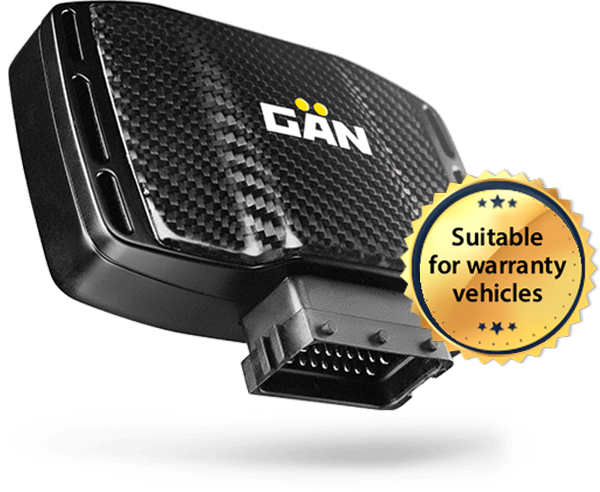
- 15 minutesfitted to the factory connectors
- IP67water and dust protection
- +12 hpwith the GAN GA+ on naturally aspirated engines
Naturally aspirated Chevrolet Spark engines pick up +6 to +12 hp.
- up to +30%more power
GAN GT: up to 30%, GAN GTL: up to 25%, GAN GA+: up to 12%.
- GAN APPpower control via smartphone
SPORT, DYNAMIC, ECO and STOCK modes in the GAN app.
- 50 daystest drive
Feel the difference or get your money back, excluding delivery costs.
Chevrolet Spark chip tuning: engines and generations
Chevrolet Spark remap: the name covers three cars
Three generations share the Spark name, yet in Europe only the M300 wore it. In Britain the new Spark was sold from 2010 to 2015 as a hatchback, with LS and LT at the top of the range, and used-car guides list it simply as the Spark 2010 to 2015. The M200 was the Chevrolet Matiz until 2010, with a 52 hp 0.8 three-cylinder and a 67 hp 1.0.
European sales of the M300, the car with the Spark badge, began in March 2010 with a 1.0 and a 1.2 petrol engine. The M400 came as the Opel Karl and the Vauxhall Viva, with a 75 hp 1.0 engine. So choosing a tuning box starts with the generation: the M200 and the M300 have different engines, and each one gets its own matched box.
The M300: the 1.0 and the 1.2
Both M300 engines are naturally aspirated four-cylinder petrols with a five-speed manual gearbox, and there is no diesel. The catalogue has the 1.0i at 67 hp and 90 Nm, and the 1.2i in two versions, 81 hp and 84 hp. A facelift followed in autumn 2012.
Geneva in 2009 was the car's first showing; top speed is 154 km/h with the 1.0 and 164 km/h with the 1.2. UK reviews call the 1.0 slow, which is the context for any power gain. The 1.2 is the stronger engine in the UK range and came with the LS and LT trims.
Matiz and the M400
The 2005 to 2010 Chevrolet Matiz is covered with the 0.8i, 52 hp and 71 Nm, an engine with three cylinders, not four. The Matiz 1.0 with 67 hp corresponds to the 1.0i at 67 hp. The M400 1.0 with 75 hp and 95 Nm is in the catalogue as well; in Europe that car is the Opel Karl or Vauxhall Viva.
Chevrolet Spark remapping: questions
Chevrolet Spark remap: which M300 engine is it, the 1.0 or the 1.2?
Match engine size and output against the catalogue: the 1.0i at 67 hp, the 1.2i at 81 hp or 84 hp. The 84 hp 1.2i, for example, rises from 84 hp and 113 Nm to 94 hp and 127 Nm with the GAN GA+. On small naturally aspirated engines the GAN GA+ is rated at up to 12% more power. Those are the stated gains for the engine type, not a dyno reading of your own car.
Matiz remap: is there a tuning box for the 0.8?
Yes. The 0.8 is the Matiz M200, which never carried the Spark name in Europe, and it takes the GAN GA+.
Is the Vauxhall Viva the Spark M400?
In Europe the M400 is sold as the Opel Karl and the Vauxhall Viva, and the 1.0 with 75 hp is covered by the GAN GA+.
Do I need to tell my insurer about a GAN tuning box?
Yes. In the UK a power increase counts as a modification, and insurers expect to be told about it before you drive with the box fitted. Each insurer handles it differently, so check with yours first and quote the before-and-after output from the table above.
Is a tuning module the same as a Stage 1 remap?
Not quite. Stage 1 usually means an ECU remap without replacing any parts. The tuning module also works without replacing parts, but it does not change the ECU software: it adjusts the sensor signals, comes off in about a minute, and the OFF button in the app restores the factory settings.