





Chiptuning Mitsubishi Galant
Up to 12% more power for your Mitsubishi Galant
Our catalogue lists 2 generations and 17 engines for the Mitsubishi Galant (2004 → 2012). For 17 engines, the options are the GAN GA and GAN GA+: the GAN GA+ adds +16 to +30 hp (GAN GA+ from 189 EUR).
Which Mitsubishi Galant do you have?
Start with the model year and chassis code. Then pick your engine by the power output shown in your vehicle documents.
Mitsubishi Galant remap: what the GAN box does and doesn’t do
More power and torque without rewriting the ECU or replacing any parts. Your manufacturer’s warranty is preserved: the ECU software is never changed, and the box can be removed at any time.
- Bluetoothchange modes from your phone
- 18 mapsfine-tuning for your engine
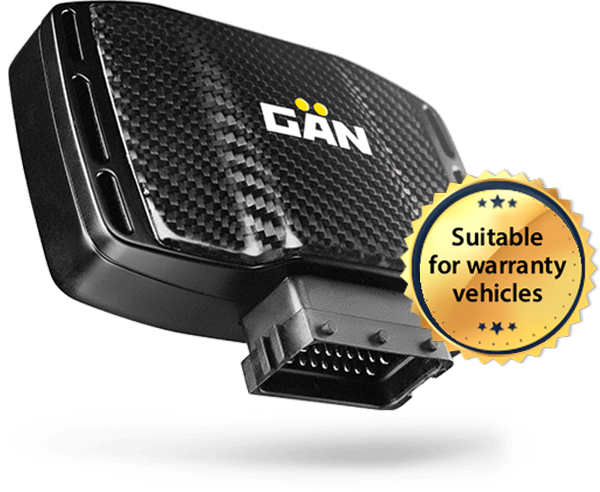
- 15 minutesfitted to the factory connectors
- IP67water and dust protection
- +30 hpwith the GAN GA+ on naturally aspirated engines
Naturally aspirated Mitsubishi Galant engines pick up +16 to +30 hp.
- up to +30%more power
GAN GT: up to 30%, GAN GTL: up to 25%, GAN GA+: up to 12%.
- GAN APPpower control via smartphone
SPORT, DYNAMIC, ECO and STOCK modes in the GAN app.
- 50 daystest drive
Feel the difference or get your money back, excluding delivery costs.
Mitsubishi Galant chip tuning: engines and generations
Mitsubishi Galant remap: the last European Galant of October 2004
October 2004 saw the last Mitsubishi Galant leave the German range. For a European car, a Galant tuning box means the eighth generation, the EA0. Mitsubishi presented it in August 1996 and sold it from 1997 as a saloon and an estate; 101,947 cars were built for Europe. Britain sold this car officially from 1997 to 2003, with trims such as GLX and GLS on the 2.0, GDI on the 2.4 and GLSi or Sport on the 2.5 V6. A box is chosen by engine, and the choice in this generation is between its petrol units. The 1997 range started with two petrols: a 2.0 making 136 hp and 178 Nm, and a 2.5 V6 making 163 hp and 223 Nm.
Under the bonnet, the 2.0 is the 4G63 and the 2.5 V6 is the 6A13. The catalogue also lists a 1.8, a 3.0 V6 and other outputs for this generation, but those are not European versions. In February 1999 the 2.4 GDI joined the line-up, with direct injection, 150 hp and 223 Nm. The October 2000 facelift changed the outputs to 133 hp, 144 hp and 161 hp, and none of those versions has a catalogue row. Facelifted cars were front-wheel drive only, with a manual or an automatic gearbox.
The ninth generation and the rest of the catalogue
Built from 2004, the ninth-generation Galant was developed for the US and was not offered in Europe. It was not a normal UK-market car either, so British buyers should not read the ninth-generation rows as figures for a UK Galant. The catalogue rows for this generation are the American 2.4 and 3.8 V6 and, from the Japanese Galant Fortis, a 1.8, a 2.0 and a 2.0 turbo. None of them is a European version. Japan calls the estate the Legnum; in Europe it is the Galant Estate or Kombi.
Mitsubishi Galant remapping: questions
Galant 2.5 V6 remap: what does the GAN GA+ add?
The GAN GA+ lifts the 2.5 V6 from 163 hp and 223 Nm as standard to 183 hp and 250 Nm. For this petrol V6 the GAN GA+ is rated at up to 12% more power. Those are the stated gains for this engine type, not a dyno reading from your own car.
Is the Galant 2.4 GDI with 150 hp covered?
Yes. The 2.4 with 150 hp, the GDI sold from February 1999, has a catalogue row.
Why are the ninth-generation Galant rows not European?
That generation came out of Illinois, built for the American market, so its 2.4 and 3.8 V6 versions are American cars.
Is the 280 hp Galant VR-4 covered?
No. The VR-4, with its twin-turbo 2.5 V6 and 280 hp, was sold only in Japan and Britain, and it has no catalogue row. In Britain the VR-4, with four-wheel drive, is a rare car.
Do I need to tell my insurer about a GAN tuning box?
Yes, declare it. British insurers treat extra power as a modification, so the safe course is to tell them before you fit the box. How they treat it varies from one insurer to another, so ask before you fit the box; the standard and tuned figures you will be asked for are in the table on this page.
Is a tuning module the same as a Stage 1 remap?
Not quite. Stage 1 usually means an ECU remap without replacing any parts. The tuning module also works without replacing parts, but it does not change the ECU software: it adjusts the sensor signals, comes off in about a minute, and the OFF button in the app restores the factory settings.