






Chiptuning Land Rover Freelander
Up to 30% more power for your Land Rover Freelander
Our catalogue lists 2 generations and 12 engines for the Land Rover Freelander (2006 → 2014). For 7 turbo engines, the options are the GAN GT and GAN GTL tuning boxes: the GAN GT adds +32 to +65 hp (GAN GT from 329 EUR, GAN GTL from 219 EUR). For 5 naturally aspirated engines, the options are the GAN GA and GAN GA+: the GAN GA+ adds +14 to +28 hp (GAN GA+ from 189 EUR).
Which Land Rover Freelander do you have?
Start with the model year and chassis code. Then pick your engine by the power output shown in your vehicle documents.
Land Rover Freelander remap: what the GAN box does and doesn’t do
More power and torque without rewriting the ECU or replacing any parts. Unlike a flash remap, the tuning box leaves the ECU software alone and only adjusts the engine sensor signals.
- Bluetoothchange modes from your phone
- 18 mapsfine-tuning for your engine
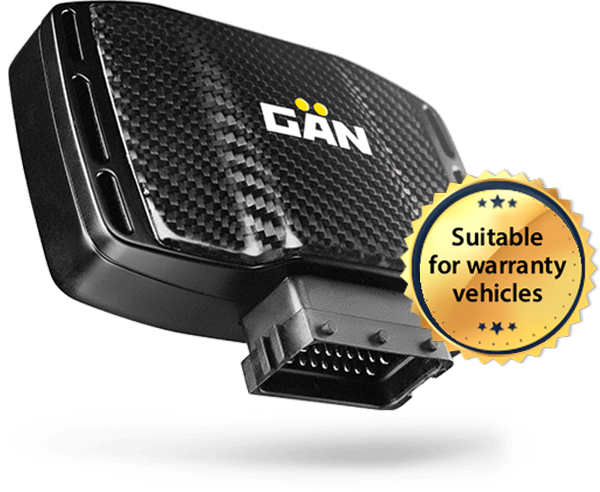
- 15 minutesfitted to the factory connectors
- IP67water and dust protection
- +65 hpwith the GAN GT on turbocharged engines
Across the Land Rover Freelander range: +32 to +65 hp with the GAN GT or GAN GTL.
- +28 hpwith the GAN GA+ on naturally aspirated engines
Naturally aspirated Land Rover Freelander engines pick up +14 to +28 hp.
- GAN APPpower control via smartphone
SPORT, DYNAMIC, ECO and STOCK modes in the GAN app.
- 50 daystest drive
Feel the difference or get your money back, excluding delivery costs.
Land Rover Freelander chip tuning: engines and generations
Land Rover Freelander remap: diesel and petrol engines
The Freelander was sold new in Britain from 1997 to 2014, as the Freelander 1 and the Freelander 2, with Td4 on the Freelander 1 and TD4 or SD4 on the Freelander 2 among the diesel badges. The first-generation Freelander 2.0 TD4 is rated at 112 hp; the catalogue row for the 111 hp version goes to 144 hp with the GAN GT. A Freelander 1 TD4 that has lost its pull deserves a check of the MAF sensor, turbo hoses and intake before you blame the standard calibration. On the Freelander 2 the diesels come first: the GAN GT lifts the 2.2 TD4 from 160 hp to 206 hp and the 2.2 SD4 from 190 hp to 244 hp.
The 2.0 Si4 petrol at 241 hp reaches 306 hp. The 1.8, the 2.5 V6 and the 3.2 i6 petrols take the GAN GA+, which is rated at up to 12% more power. All of these are stated gains for the engine types, not a dyno reading of your car.
Land Rover Freelander remapping: questions
Freelander 2.2 TD4 at 150 or 160 hp, or SD4 at 190: how do you tell which you have?
Until July 2010 the 2.2 TD4 made 160 hp and 400 Nm; after that it made 150 hp, and the 190 hp SD4 was introduced at the same time, both at 420 Nm. With the GAN GT the 150 hp car reaches 193 hp. The 2.2 diesel is timed by a belt, not a chain, and a belt that snaps does severe damage to the engine. Check when the belt was last changed before you fit any box. Those are stated gains, not a dyno reading of your car.
Freelander TD4 remap or GAN tuning box: how do they differ?
A remap replaces the software in the control unit; the GAN box leaves that software as it is and only adjusts the signals from the engine sensors. The ECU software is never changed, so your manufacturer's warranty is preserved, and the box can be taken off at any time.
Do I need to tell my insurer about a GAN tuning box?
Yes. In the UK a power increase counts as a modification, and insurers expect to be told about it before you drive with the box fitted. Each insurer handles it differently, so check with yours first and quote the before-and-after output from the table above.
Is a tuning module the same as a Stage 1 remap?
Not quite. Stage 1 usually means an ECU remap without replacing any parts. The tuning module also works without replacing parts, but it does not change the ECU software: it adjusts the sensor signals, comes off in about a minute, and the OFF button in the app restores the factory settings.